Machine Learning vs. Deep Learning vs. Generative AI: Where Should You Start?
Confused by AI jargon? Learn the difference between Machine Learning, Deep Learning, and Generative AI, and where you should invest your time to stay ahead.

You’re in a meeting, and the buzzwords start flying: ""We should leverage machine learning for that,"" someone says. Another person counters, ""No, this needs a deep learning model."" Then your boss chimes in, ""What's our generative AI strategy?""
It's a fog of technical terms. Most people use them interchangeably, but the truth is, they represent fundamentally different concepts. Knowing the difference isn't just about sounding smart-it's about knowing where to invest your most valuable asset: your time.
If you’re a business professional, you don’t need a PhD in computer science. You need a clear map. This guide will provide exactly that, so you can stop being confused by the jargon and start leading the conversation.
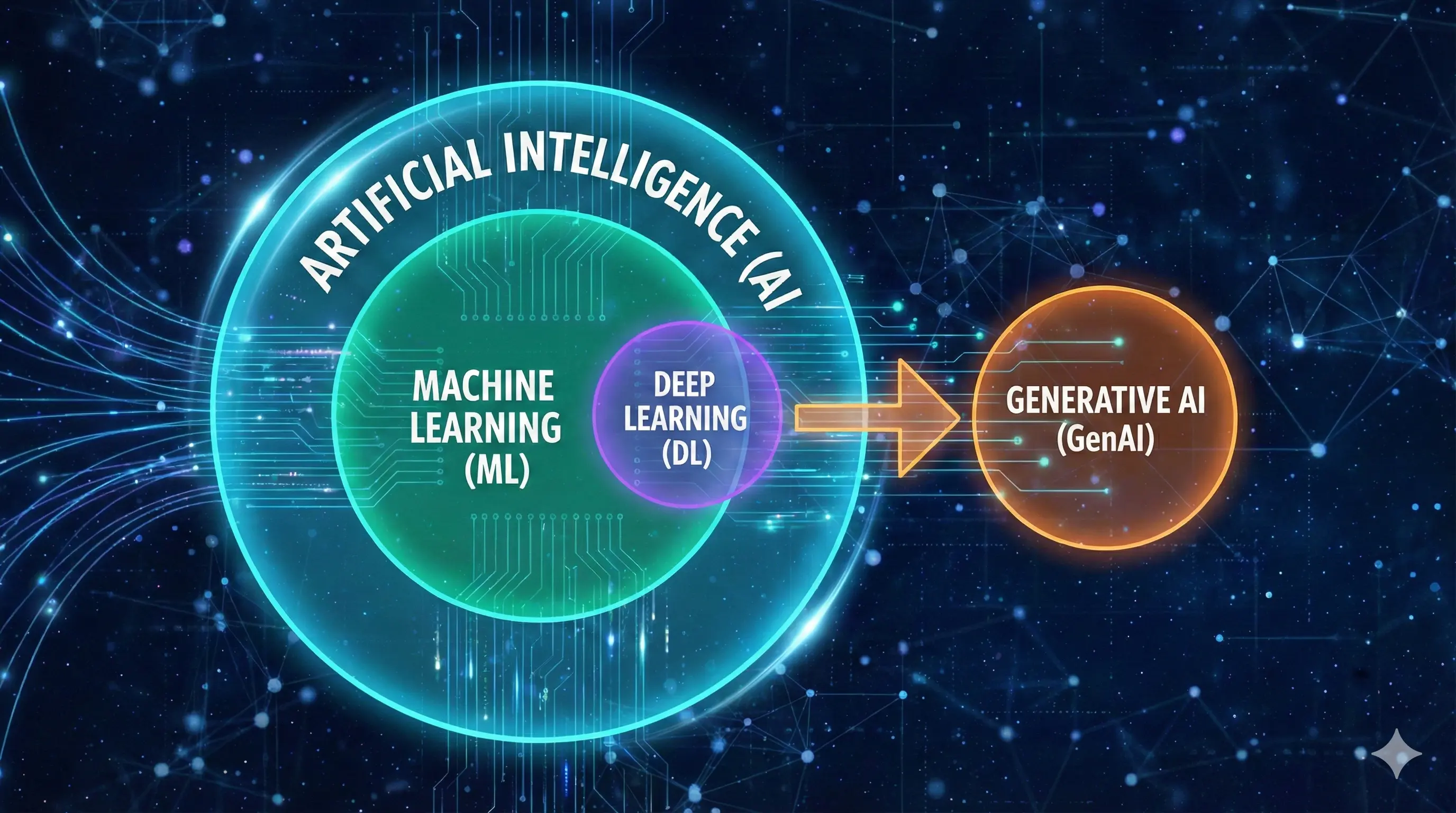
The Hierarchy: Think of AI as a Russian Nesting Doll
The easiest way to understand these terms is to visualize a set of Russian Nesting Dolls.
Artificial Intelligence (AI) is the largest, outermost doll. It's the broad, overarching field of making machines smart and capable of human-like tasks.
Machine Learning (ML) is the next doll inside. It’s a subset of AI that focuses on teaching computers to find patterns in data to make predictions.
Deep Learning (DL) is an even smaller doll inside ML. It's a highly advanced type of machine learning inspired by the human brain’s structure (neural networks).
Generative AI (GenAI) is a specialized and powerful application that emerged from deep learning.
The key takeaway? You don't need to know how to build the inner dolls to be an expert at using the outer ones.
Machine Learning (ML): The Pattern Spotter
At its core, Machine Learning is about prediction. You feed it historical data, and it learns to spot patterns to answer a question about the future.
Simple Definition: Teaching a computer to make an educated guess based on past experience.
Business Example: Lead Scoring. Your CRM has data on thousands of past leads-which ones converted and which ones didn't. An ML model can analyze all that data to predict the likelihood of a new lead converting, allowing your sales team to focus their efforts.
Your 2026 Verdict: As a business leader, you need to understand the capability of ML. Know what problems it can solve (like fraud detection or demand forecasting), but don't spend months learning the algorithms unless you plan to become a data scientist.
Deep Learning (DL): The Brain-Inspired Engine
Deep Learning is the powerhouse that drives many of the ""magical"" AI experiences we use daily. It's a complex form of ML that uses ""neural networks"" to process unstructured data like images, sound, and natural language.
Simple Definition: A more advanced type of ML that can learn from vast, messy datasets without human intervention.
Business Example: Facial Recognition & Voice Assistants. The technology that allows your phone to recognize your face (FaceID) or a smart speaker to understand your command (Siri) is powered by deep learning.
Your 2026 Verdict: The technical barrier here is extremely high. Leave this to the specialists. Understanding that DL is the ""engine"" behind many modern tools is enough for 99% of professionals.
Generative AI (GenAI): The New Creative Partner
This is the technology that has changed everything for non-technical professionals. Generative AI doesn't just predict or recognize-it creates. It uses its deep learning foundation to generate entirely new content.
Simple Definition: An AI that can create new text, images, code, or music based on a prompt.
Business Example: Marketing Campaigns. You can use GenAI to brainstorm 20 different ad headlines, draft a blog post, generate a unique image for a social media campaign, and write a follow-up email sequence-all in a matter of minutes.
Your 2026 Verdict: THIS is where you start. GenAI has the lowest barrier to entry and the highest immediate return on investment for your time. Mastering these tools is a non-negotiable career skill. `[Internal Link: We believe so strongly in this that our entire ""Try-First vs. Concept-First"" learning philosophy is built around it.]`
| Feature | Machine Learning (The Predictor) | Generative AI (The Creator) |
Machine Learning (The Predictor)
Input : Structured data (spreadsheets, databases)
Primary Goal : Predict a single, probable outcome (e.g., a number or a category)
Key Professional Skill : Data interpretation and statistical thinking
Generative AI (The Creator)
Input : Natural language prompts (your questions)
Primary Goal : Generate a range of new, creative outputs (e.g., text or images)
Key Professional Skill : Prompting, critical evaluation, and strategic thinking
The BotBrained Rule: Certainty vs. Creativity
In our enterprise consulting, we see companies make an expensive mistake: trying to use a creative tool for a certainty problem. To avoid this, we teach our students the ""Certainty vs. Creativity"" rule:
If you need a single, certain, data-driven answer (like predicting next quarter's sales or identifying which customers are at high risk of churning), you have a classic Machine Learning problem.
If you need a range of creative possibilities, a synthesis of complex ideas, or a first draft of something new, you have a Generative AI problem.
Knowing which tool to apply to which problem is a mark of true business judgment.
Your 2026 Learning Roadmap: Where to Invest Your Hours
Don't boil the ocean. Apply the 80/20 rule to your learning:
Spend 80% of your time on Generative AI. This is the hands-on part. Get exceptionally good at operating the tools, mastering prompting techniques, and building simple AI-powered workflows. This delivers immediate career ROI.
Spend 20% of your time on Machine Learning Logic. This is the conceptual part. You don't need to learn the math, but you should understand the basics of data quality, the dangers of bias in training data, and how to evaluate the outputs of a predictive model.
The One Skill That Rules Them All
The tools will change. The models will get smarter. But the one timeless skill that will always be valuable is your business judgment.
Knowing which questions to ask, how to evaluate the AI's output against your strategic goals, and when to trust the machine versus your own intuition is what separates a casual user from an indispensable leader. That’s not a technical skill-it's a professional one.
Ready to move from theory to execution and build the business judgment that will define your career? Enroll in the BotBrained AI for Professionals program